Recent acquisitions: Centurion tank log books
10 November 2008 by Craig Berelle. Collection, New acquisitions, News Comments (9)
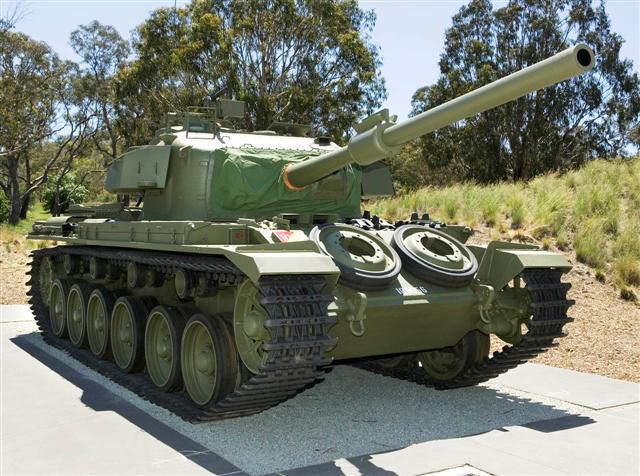
A log book can reveal performance characteristics, reveal battle damage and document repairs made during each vehicle’s period of service. The Memorial’s Research Centre has acquired log books of six Centurion tanks that served in the Vietnam War, including vehicle No. 169056, proudly on display adjacent to Anzac Hall. The log books are in Official Records Series AWM350, and can be viewed in the Memorial’s Research Centre.
Centurion 169056By examining some of the twelve sections of the log book, the reader can gain a useful insight into the technical history of a tank as well as develop an appreciation for the conditions that enabled the vehicle to operate for over 25 years. The log books don’t always have every section filled out, and are not always ‘continuous’ for the vehicle’s entire life of service, as the books were often replaced.Â
Engine specifications: Rover Meteor Mark 4B 60° “V” 12 cylinder, 27 litre (1650cubic inch), developing 485 kW (650 bhp) at 2550 rpm
Main sections:
- Main engine history card and modification certificate;
- Vehicle mileage and hours running;
- Transfers between units and drivers;
- Inspections and classifications;
- Authorised modifications;
- Repairs, overhauls and assembly changes.
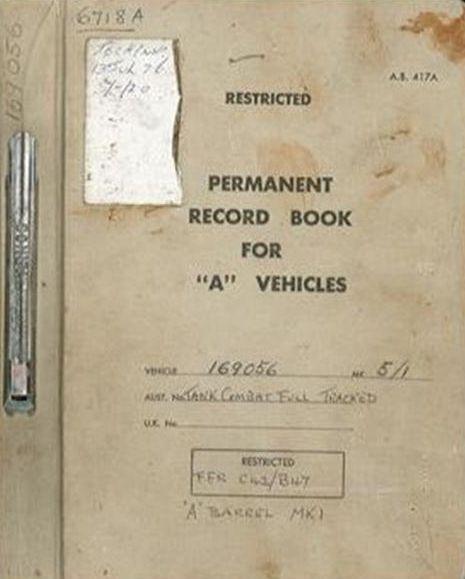
How did the numbers stack up for Centurion 169056? The record shows how this tank:
- Clocked up 861 miles to June 1971;
- Performed with 2 engine and 3 gearbox changes;
- Underwent 132 individual modifications at 4 Base Workshop Battalion, Bandiana.
Â
About the tank:
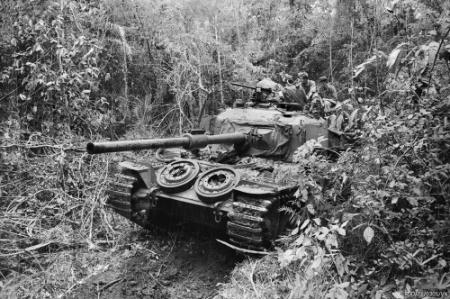
Centurion 169056 was purchased from the UK as a new Mk3 in the early 1950s. It was converted to a Mk5 and later Mk5/1 in the 1960s. The tank was sent to South Vietnam in Sept/October 1970 aboard a Landing Ship Medium (LSM). Initially given the squadron call sign 92C, Centurion 169056 later became part of 5 Troop with call sign 5 Bravo (5B). It took part in Operation ‘Iron Fox’ in June 1971 when the barrel was struck by an RPG (rocket propelled grenade), wounding the driver.


November 17th, 2008 at 3:07 pm
Our regiment 1/15 RNSWL gave up a number of our Centurions to 1 ARMD for service in Vietnam. We have a fully working example in our museum that saw Vietnam service – crewed by members of the Museum Association who were old tankie crewmen from the 1960’s. A typical example of British technology of the 1950’s – nothing is easy to get at or work on!
November 21st, 2008 at 3:29 pm
I was under the impression that the tank on display at the museum was 4B out of 4 Troop, 5 Troop is a new one for me, it must have been compiled in the late 70’s in Vietnam, could any of the readers help me with this quandary.
November 27th, 2008 at 10:46 am
Hi Greg,
4B was on display inside the AWM. When the refurbishment work was done, however, there was no longer any room for a Centurion inside. The RAAC and 1st Armd Regt Honorary Colonels obtained approval from the AWM Council for a Centurion to be located in the grounds of the AWM. It was decided that 4B was too significant a vehicle to allow it to deteriorate outdoors and it was moved to the AWM Annexe at Michelle (where a number of other major iems of military equipment are also located). Whatever arrangements are made to display 4B permanenetly in the future, it’s condition will be preserved. (Public open days are held at Mitchell periodically at present.)
Re 169056…the Chief of the Army allowed a tank to be relocated from the parade ground at Puckapunyal (replacing it with a Leopard). The AWM did significant restoration work and site preparation. A panel in the Vietnam Gallery informs visitors about the tank outside. The panel is located next to the barrel from 5A that was damaged in the same contact in which the driver of 5B was WIA.
Hope this explains. Best wishes, Bruce
November 27th, 2008 at 6:42 pm
Hi again Greg,
I forgot to explain about 5 troop…here’s a message I posted on the Black Berets site recently:
C Sqn, 1 Armd Regt, RAAC (1971) were the first sqn to create a troop which was designated as 5 Troop. Some other sqns in SVN used their 20 tanks to deploy five troops, but generally referred to the fifth troop as a composite troop. One sqn decided against deploying a fifth troop and used their SHQ and dozers tanks as replacements to maintain four troops.
1971 wasn’t the first time that a 5 Troop was deployed. During the Second World War, tank regiments used to be like inf battalions in which platoons (troops) were numbered sequentially, eg. today we have 9Pl, C Coy (then they used to have 9 Troop, C sqn). I’ve been trying to get a date for when the change to 1 to 4 troop per squadron came about, but have been unsuccessful. (It’s been a bit like trying to find out when trooper became a rank…but I got there, so maybe’s there’s some hope.)
Hope this explains, Bruce
November 29th, 2008 at 3:26 pm
I was under the impression that the tank at the Lancers Museum was 169126 and believe it never served in Vietnam. Would welcome any info on its service?? Regards Col
December 5th, 2008 at 3:32 pm
Hi Col,
I think when greg refers to the tank on display at the museum, he’s referring to the AWM, rather than the Lancers Museum. The Lancers webite confirms that their vehicle is 169026. There are some details on the Lancers site which aren’t quite correct re Centurion. Happy to comment if you wanted to compare with your info at the VVF Museum. (Happy to discuss with Lancers Museum as well.)
Regards, Bruce
August 31st, 2009 at 6:53 pm
i wonder if they have the log for 33bravo 169109 ? ill make enquiries.
September 24th, 2009 at 4:19 pm
Hi Bruce yes I was referring to the Lancers Museum and I think you missed a key there. The Lancers Museum is 169126 where as 169026 is in private hands, Regards Col
September 24th, 2009 at 4:22 pm
Hi Mike, do not know if they have the log or not but 169109 is now in Queensland owned by Brad Baker and stored on the property of Alan Hill. Interesting, Alan agreed to store the tank before he found out it was the one he served on in Vietnam as a Gunner, small world indeed!