The opening of the Australian War Memorial
The Australian War Memorial was open to the public by the Governor-General, Lord Gowrie on 11 November 1941. More than 5000 people attended the event, including Prime Minister John Curtin, General Sir Thomas Blamey and 18 recipients of the Victoria Cross.
Since then, the Memorial has become a place of national remembrance, honouring Australians who have served and died in war and on active service.

Aerial view of the Australian War Memorial taken the day before the official opening of the Memorial on Remembrance Day 1941.
More than a monument
The Memorial is more than a building. It brings together objects and stories from the National Collection to explore Australia's experience of war and peacekeeping.
Housed within its distinctive sandstone building and copper-clad dome, the collection includes military relics, official and personal records, art, photographs, film and sound recordings. Together, these materials help tell the stories of Australians who have served in the First and Second World Wars, regional conflicts and international peacekeeping operations.

First World War naval uniforms on display on mannequins in a showcase at the Australian War Memorial, as seen around the time of the Memorial's opening in 1941.
Designing the Memorial
In 1927, an architectural competition was held to design an Australian war memorial, but no clear winner emerged. Two entries stood out: those of Sydney architects Emil Sodersteen and John Crust.
Sodersteen proposed a monumental Art Deco design featuring a domed Hall of Memory. Crust's design included arched cloisters to house the Roll of Honour and provide a place for reflection and remembrance. Although their approaches differed, both designs offered important elements for the future Memorial.
The architects were invited to combine their ideas into a joint design. Their proposal was accepted but construction did not begin until 1934. Sodersteen left the project in 1938, and Crust oversaw the building's completion.

Canberra, ACT. c. 1941. A plaster model of the Australian War Memorial detailing the layout of the proposed lawns and gardens surrounding the building.

Construction of the Australian War Memorial commenced in 1929 with a budget of £250,000. Shown here is a detail of the construction of the Dome in August 1940.

Construction of the Australian War Memorial commenced in 1929. Shown here is a detail of the Commemorative Area and parapet under construction.

Workmen surrounded by scaffolding and building equipment pause during the construction of the outer wall of the south facing arched window of the Hall of Memory at the Australian War Memorial.
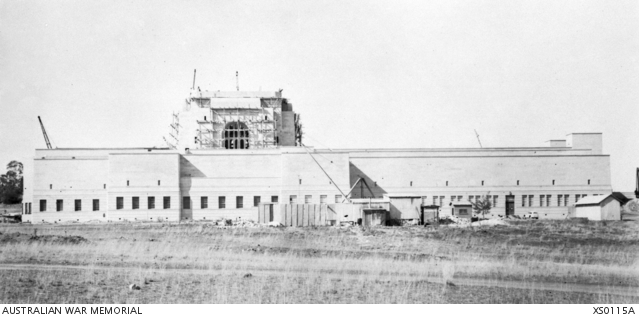
Canberra, ACT. 1940-08. Construction of Hall of Memory is almost complete but work on the dome has not yet commenced.
The Memorial's opening
As the Second World War began, the Memorial was still under construction. It opened to the public on Remembrance Day, 11 November 1941, with the essential form of the building we know today.
The Memorial was originally intended to focus primarily on the First World War. However, the scale of the Second World War led to an expansion of its role. In 1941, the Australian government extended the Memorial's charter to include the Second World War. In 1952, the charter was broadened again to cover all wars in which Australians had served.
The building’s original design remains at the heart of the Memorial today, providing a place to remember those who served and to explore Australia’s wartime experience.

Onlookers line the front entrance of the Australian War Memorial at the ceremony for the building's opening in 1941. Mount Ainslie is visible in the background.

Onlookers line the road at the main entrance of the Australian War Memorial at its opening in 1941.

Canberra, ACT. 11 November 1941. Members of the WRANS marching during the parade at the opening day ceremonies at the Australian War Memorial. Nine WRANS, including WR3 Pat Ross, WR1 Frances Provan, WR12 Judy Alley, WR4 Denise Owens, WR2 Joan Furley, WR15 Beatrice Ogilvie, WR7 Daphne Wright, WR10 Joan Hodges and WR6 June Macleod participated in the ceremony. These women were among the initial group of fourteen who formed the WRANS and were drafted to HMAS Harman. (Donor D. Wright)

Canberra, ACT. 11 November 1941. Members of the RAN from HMAS Harman, RAAF from RAAF Base Fairbairn, Cadets from Duntroon Military College, and members of the Women's Royal Australian Navy Service (WRANS) participating in the opening day ceremonies at the Australian War Memorial. Nine WRANS, including WR3 Pat Ross, WR1 Frances Provan, WR12 Judy Alley, WR4 Denise Owens, WR2 Joan Furley, WR15 Beatrice Ogilvie, WR7 Daphne Wright, WR10 Joan Hodges and WR6 June Macleod participated in the ceremony. These women were among the initial group of fourteen who formed the WRANS and were drafted to HMAS Harman. (Donor D. Wright)

Official guests in the flag-bedecked dais at the opening ceremony of the Australian War Memorial

Canberra, ACT. c. 1941. The Australian War Memorial viewed from the north east. Note the completed copper dome above the Hall of Memory and the Library (centre behind open windows).

CANBERRA, ACT, 1941-11-11. RAAF CONTINGENT MARCH IN PARADE AT THE OFFICIAL OPENING CEREMONY OF THE AUSTRALIAN WAR MEMORIAL. IN THE BACKGROUND (RIGHT) IS THE CANBERRA HIGH SCHOOL WITH REID OVAL FAR RIGHT. (DONOR J. CLANCY)

Canberra, ACT. c. 1941. The Australian War Memorial viewed from the south east slope of the hill below the building. Note the completed copper dome above the Hall of Memory and the horses and carts which transported building supplies to the construction site, and the shed bearing the words Simmie & Co. Plumbers.

The architect behind the Memorial
Discover the remarkable collection of architectural plans and drawings found more than 70 years after the Australian War Memorial opened, revealing the story behind its design and construction.

A Home on the Southern Hill
Discover the vision behind the Memorial, from C.E.W. Bean’s early ideas to the plans, artwork and stories that shaped the building into a place of remembrance.