Origins of Remembrance Day
Why is Remembrance Day special to Australians?
At 11 am on 11 November 1918 the guns on the Western Front fell silent after more than four years of continuous warfare.
The allied armies had driven the German invaders back, inflicting heavy defeats upon them over the preceding four months. In November the Germans called for an armistice (suspension of fighting) in order to secure a peace settlement. They accepted allied terms that amounted to unconditional surrender.
The 11th hour of the 11th day of the 11th month soon gained special significance. The moment when hostilities ceased on the Western Front became associated with remembering those who had died in the war.
This First World War had mobilised more than 70 million people and left between 9 and 13 million dead, perhaps as many as one-third of them with no known grave. The allied nations chose this day and time to commemorate their war dead.
The two minutes silence
On the first anniversary of the armistice in 1919, two minutes' silence was introduced as part of the main commemorative ceremony at the new Cenotaph in London.
The silence was proposed by Australian journalist Edward Honey, who was working in Fleet Street. At about the same time, a South African statesman made a similar proposal to the British Cabinet, which endorsed it.
King George V personally requested that the people of the British Empire suspend normal activities for two minutes at the hour of the armistice. The two minutes' silence was widely adopted and became a central feature of Armistice Day commemorations.
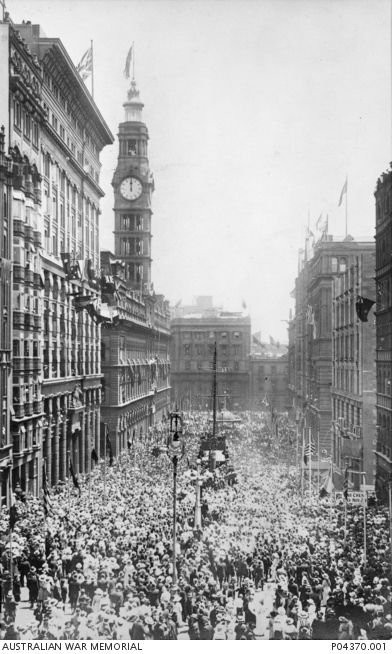
Sydney, NSW, 11 November 1919. The view from Castlereagh Street looking down towards George Street, of a large crowd which has gathered in Martin Place to celebrate Armistice Day. The clock on the GPO building says twelve o'clock and a replica sailing ship float has been set up in the centre. A bandstand with a domed roof is visible in the background.
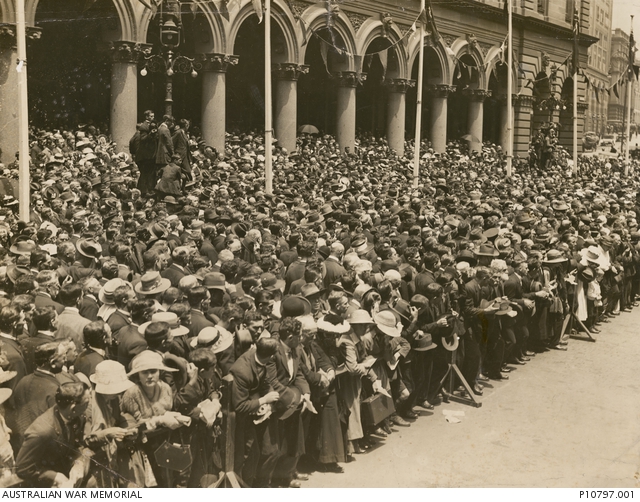
Crowds at Martin Place at the conclusion of the first two minutes silence for Remembrance Day 1919.
The unknown soldier
On the second anniversary of the armistice in 1920, the commemoration was given added significance with the return of the remains of an unknown soldier from the battlefields of the Western Front.
Unknown soldiers were interred with full military honours in Westminster Abbey in London and at the Arc de Triumph in Paris. More than one million people visited the unknown soldier's tomb in London within a week to pay their respects.
Over the following decade, most other Allied nations adopted the tradition of entombing unknown soldiers.
Remembrance Day
After the end of the Second World War, the Australian and British governments changed the name from Armistice Day to Remembrance Day.
Armistice Day was no longer an appropriate title for a day that commemorated all war dead.
In Australia, the 75th anniversary of the armistice in 1993 brought Remembrance Day ceremonies to the focus of national attention.
The remains of an unknown Australian soldier, exhumed from a First World War military cemetery in France, were ceremonially entombed in the Memorial's Hall of Memory.
Remembrance Day ceremonies were conducted simultaneously in towns and cities all over the country. They culminated at 11 am and coincided with the traditional two minutes' silence.
The ceremony touched a chord across the Australian nation and helped re-establish Remembrance Day as a significant day of commemoration.
Four years later, in 1997, Governor-General Sir William Deane issued a proclamation formally declaring 11 November as Remembrance Day. He urged all Australians to observe one minute's silence at 11 am each year to remember those who died or suffered for Australia's cause in all wars and armed conflicts.
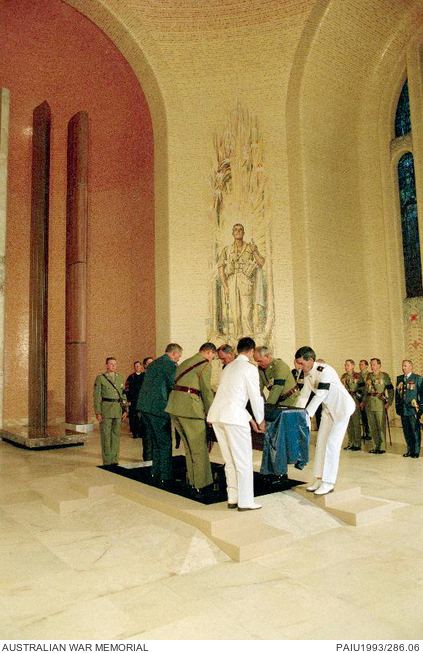
11 November 1993. Entombment of the Unknown Australian Soldier. The Bearer Party lowers the coffin into the tomb in the Hall of Memory.